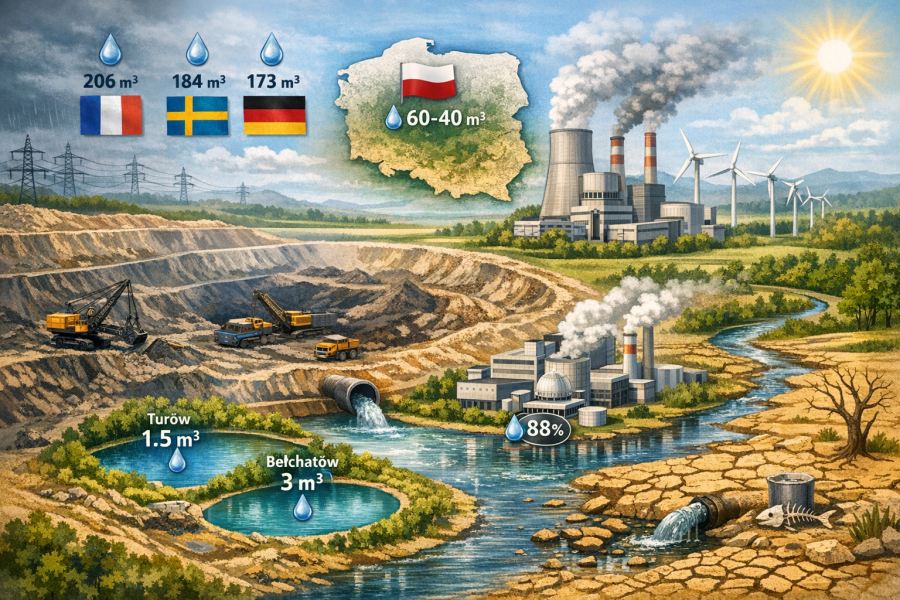
Poland is a water-scarce country with average annual water resources amounting to around 60 billion cubic meters, and during drought periods this figure can fall below 40 billion cubic meters. By comparison, France has the largest water resources in the EU at 206 billion cubic meters, followed by Sweden with 184 billion cubic meters and Germany with 173 billion cubic meters.*
Poland ranks among the leading countries in terms of water abstraction for energy production. According to the Central Statistical Office of Poland, in 2024 the generation and supply of electricity, gas, steam, and hot water consumed 4,765 hm³ of water (88% of total industrial water use).*** This marks a significant decrease (over 15%) compared with the 5.7 billion cubic meters used for the same purposes in 2022. The decline demonstrates the substantial benefits for sustainable water management resulting from Poland’s rapid phase-out of coal-based power generation and coal mining. At the same time, it highlights the scale of the challenges ahead.
LIGNITE OPEN-PIT MINES AND FUTURE WATER DEMAND FOR THEIR RECLAMATION
The operation of any lignite open-pit mine has a profound negative impact on local water relations within the area impacted by the depression cone. A depression cone is created by mine dewatering, which is necessary to ensure safe extraction of the lignite deposit.
Reclaiming the Turów open-pit mine will require 1.5 billion cubic meters of water, while the reclamation of the Bełchatów open-pit mine will require 3 billion cubic meters - together amounting to more than 10% of Poland’s water resources during drought periods (3.75% and 7.5%, respectively). This volume is comparable to Poland’s total annual water consumption for electricity, gas, steam, and hot water generation in 2024.
PGE - Polish state-owned utility operating both mines - schedule foresees shutting down the first units at the Bełchatów Power Plant in 2030 and the last in 2036. The phase-out process at Turów will begin at a similar time although the exact dates of power units closure have not yet been confirmed.
This means that the reclamation of lignite open-pit mines - requiring billions of cubic meters of water to flood the pits and create new artificial water reservoirs - will begin sooner than originally planned.
POLISH GOVERNMENT ENERGY PLANS AND WATER RESOURCES
All conventional power plants, including nuclear plants, generate electricity by heating water and converting it into steam that drives turbines. This makes the lack of analysis regarding water availability for power plant cooling - and the impact of power plants on water availability for other users - particularly concerning in the Polish National Energy and Climate Plan and in the strategies of Poland’s largest energy companies.
Government policies fail to take into account the fundamental changes in the hydrological cycle and the impact of rising average temperatures in Poland on the availability of surface water resources, particularly during summer months.
THE IMPACT OF THE TURÓW LIGNITE MINE ON REGIONAL WATER CONDITIONS - NOW AND IN THE FUTURE
The dispute with the Czech Republic over Turów was fundamentally a dispute over water and cost Poland over 100 million euros.
The latest hydrogeological assessment of the Turów lignite mine shows that the anti-filtration barrier constructed under the Polish-Czech agreement of February 2022 by PGE has produced only limited and local effects. It does not resolve the key issue of the regional depression cone or the long-term consequences of land dewatering.
Over the past five years, two major changes have significantly affected water conditions in and around the Turów mine:
- the construction of the anti-filtration barrier along the Czech border, and
- the increased depth of deposit drainage and mining operations.
According to hydrogeological expert Phd Sylwester Kraśnicki, the underground anti-filtration barrier operates only locally and does not halt the regional depression cone. Construction was completed in 2022 and testing concluded a year later. The increased mining depth - reaching approximately 300 meters - was preceded by deeper dewatering, including below the base of the deposit.
Deeper drainage expands both the reach and depth of the existing depression cone around Turów. This leads to further lowering of groundwater levels and at least partially offsets the intended effects of the anti-filtration barrier.
Although seven years have passed since the Environmental Impact Assessment report for Turów lignite mine expansion was prepared, PGE still lacks a detailed reclamation concept for the open-pit mine.
The hydrogeological assessment strongly questions the feasibility of filling the final reservoir with surface water. PGE plans assumed that the final basin would be filled with water from the Lusatian Neisse River over approximately 35–37 years.
Declining average annual flows of the Lusatian Neisse mean decreasing available water resources that could be used to fill the Turów pit. Prolonged hydrological low-flow periods will lead to interruptions in water abstraction to maintain minimum river flows. By the end of the 21st century, it may even become impossible to abstract water from the river for several months each year.
Hydrological data analysis shows that both average and minimum flows of the Lusatian Neisse are steadily decreasing. If current trends continue:
- average river flow could decline by 50–60% by the end of the century,
- minimum flows could drop by 60–70%,
- and the river itself could periodically dry up.
This means that the sooner pit flooding begins, the greater the water resources available and the faster the reclamation process can be completed.
The long-term effects of dewatering may burden the region for decades and full reclamation could take over 100 years. A detailed reclamation plan for the Turów pit is urgently needed. An earlier economic closure of the mine cannot be ruled out, and therefore a comprehensive and publicly available reclamation strategy must be developed as soon as possible.
Recommendations
Key actions to establish effective water-use regulation in the energy sector:
Regulatory transparency regarding water use
Without publicly accessible, up-to-date data, decision-makers lack a full picture of water demand and usage, preventing the implementation of sound water-saving and resource allocation policies.
The PGE Group and its subsidiary PGE GiEK S.A. must prepare detailed reclamation plans for both the Turów and Bełchatów lignite mines. An earlier economic closure scenario cannot be excluded, and therefore a comprehensive and publicly available reclamation strategy must be developed urgently.
Integrated water and energy management
This requires combining analyses of existing water resources, their future trends, changing demand among major users, and water requirements for energy production.
In particular, the government and Poland’s largest energy companies - Orlen, Enea, PGE, and Tauron - should develop and publish policies explaining how implementation of the national energy strategy and corporate strategies will affect the availability and quality of water resources in the river basins where new conventional power plants (including nuclear and SMRs) are planned.
This is especially important given the absence of such analysis in the latest version of the Polish National Energy and Climate Plan.
Finally, strict limits should be established on heat discharge into water bodies (in the case of open cooling systems), along with radical seasonal restrictions depending on available water resources and water and air temperatures.
* Statistics Poland, Environment 2025, p. 52.
** Statistics Poland, Environment 2025, p. 54.
*** Statistics Poland, Environment 2025, p. 60. As in previous years, industry accounted for the largest share (68%) of total national water consumption (5,491 hm³).