The year 2025 closed with a decline in gross domestic electricity consumption in the National Power System (KSE). According to data from Polish Power Grids (PSE), total consumption amounted to 167.48 TWh, representing a year-on-year decrease of 0.87%, i.e. 1.47 TWh less than in 2024.
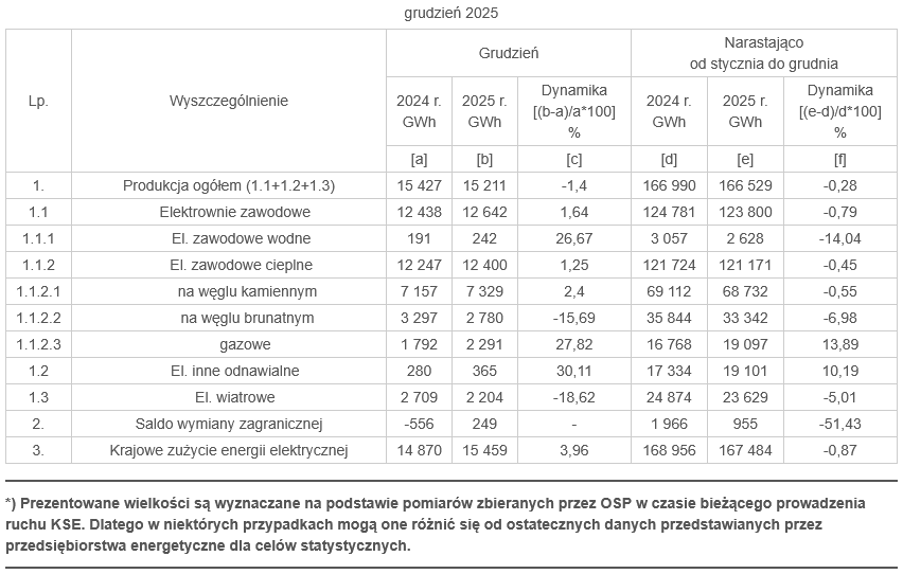
PSE data
This marks yet another year of sideways drift in Poland’s electricity consumption, despite strong economic growth and repeated media claims that electricity use is rising. The year 2025 goes down as another year of relatively low electricity consumption - clearly below the levels recorded in 2024, 2023, and every year since 2019, with the exception of the pandemic year 2020.
Annual figures: where does 2025 stand compared with recent years?
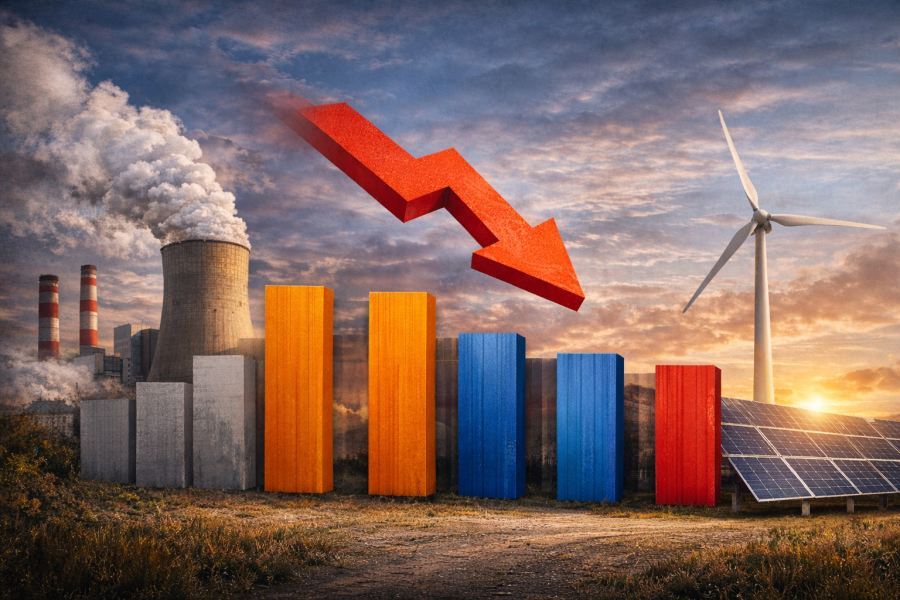
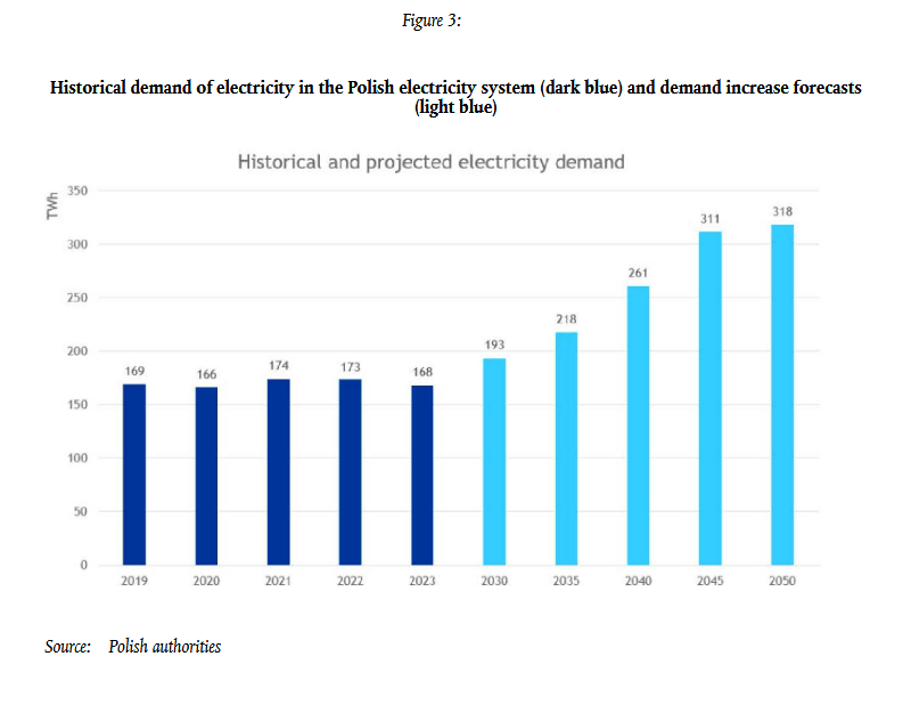
The chart above comes from the notification submitted to the European Commission regarding the intention to grant state aid to Polish Nuclear Power Plants for the construction and the first 40 years of operation of Poland’s first nuclear power plant. Similarly, the latest version of the National Energy and Climate Plan published by the Ministry of Energy in December 2025 assumes a strong increase in electricity consumption by 2030.
Meanwhile, hard data show that compared with the pandemic year 2020, electricity consumption five years later was less than 2 TWh higher, and significantly lower not only than in 2021 and 2022, but also than in 2018. This means that despite rising peak demand and recent records in electricity demand and generation, fewer sources operating year-round will be needed, and more sources capable of generating power during periods of low output from renewables. Technologies such as nuclear power and coal-fired plants will be forced into increasingly long shutdowns during particularly sunny and windy weeks and months, which - given their high fixed costs - will negatively affect profitability.
“Assuming an average annual increase in domestic electricity consumption of more than 5 TWh year on year over the next five years is wishful thinking and living in the clouds - especially since it is no secret that the negative impact of the demographic crisis on the economy will intensify, offsetting at least part of the projected growth in electricity demand.” - comments Kuba Gogolewski, Programme Director at Mission Possible.
In 2025, electricity consumption ended at a level similar to that of 2017. Compared with 2021, domestic electricity consumption in 2025 was almost 7 TWh lower.
- 2021 - 174.4 TWh, the highest year-on-year increase in demand in the last decade (+8.8 TWh)
- 2022 - 173.48 TWh of gross domestic electricity consumption
- 2023 - 167.52 TWh, a sharp year-on-year decline
- 2024 - 168.96 TWh, a slight rebound (+0.86% y/y)
- 2025 - 167.48 TWh, another decline (-0.87% y/y)
In practice, this means that the entire increase recorded in 2024 was wiped out in 2025, and consumption returned almost exactly to the levels observed in 2023. The difference between 2024 and 2025 - 1.47 TWh - is roughly equivalent to one average low-demand summer month.
Scale of the decline: modest, but systemic
A drop of 0.87% is not a dramatic collapse. However, it is worth noting that:
- 1.47 TWh annually equals around 120 GWh per month,
- this also corresponds to about 10% of consumption in a typical autumn month, such as October.
This indicates that we are not dealing with a single anomalous month, but rather with the cumulative impact of higher self-consumption during months with high solar irradiation, given that the vast majority of Poland’s prosumer energy sector is based on solar power.
2025 in a longer-term perspective
Looking more broadly, 2025 fits into a picture in which:
- consumption levels remain clearly below the record highs of the early 2020s,
- electricity consumption in 2019 (approx. 169.4 TWh) is still higher than in 2025,
- after the pandemic low of 2020, the system has not returned permanently to a growth trajectory.
From a purely statistical point of view, 2025 is not an exceptional year, but it confirms the consolidation of a clear sideways trend in domestic electricity consumption in the KSE in recent years. It also does not support the projections of extremely strong growth in electricity demand forecast by the Ministry of Energy, ARE, and PEJ S.A. for the coming years.
“If model results do not align with actual readings, it is high time to revise some of their assumptions.” - says Kuba Gogolewski - "One of the key tests that decision-makers planning the development of Poland’s power sector must carry out is a demographic stress test - checking how sensitive the models currently used as a baseline are to less optimistic, and even outright pessimistic, demographic assumptions.”